Violent aftermath of Mexico’s ‘El Mencho’ killing follows pattern of other high-profile cartel hits
Members of the Jalisco New Generation Cartel have set up roadblocks and attacked property and security forces in the days following their leader’s death.
Angélica Durán-Martínez, Associate Professor of Political Science, UMass Lowell
24 February 2026
The death of a major cartel boss in Mexico has unleashed a violent backlash in which members of the criminal group have paralyzed some cities through blockades and attacks on property and security forces.
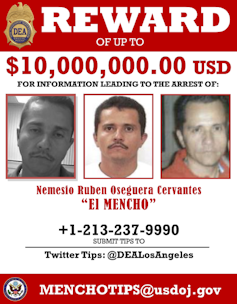
At least 73 people have died as a result of the operation to capture Nemesio Oseguera Cervantes, or “El Mencho.” The head of the Jalisco New Generation Cartel was seriously wounded during a firefight with authorities on Feb. 22, 2026. He later died in custody.
As an expert in criminal groups and drug trafficking in Latin America who has been studying Mexico’s cartels for two decades, I see the violent aftermath of the operation as part of a pattern in which Mexican governments have opted for high-profile hits that often lead only to more violence without addressing the broader security problems that plague huge swaths of the country.
Who was ‘El Mencho’?
Like many other figures involved in Mexico’s drug trafficking, Oseguera Cervantes started at the bottom and made his way up the ranks. He spent some time in prison in the U.S., where he may have forged alliances with criminal gangs before being deported back to Mexico in 1997. There, he connected with the Milenio Cartel, an organization that first allied, and then fought with, the powerful Sinaloa Cartel.
Most of the information available points to the Jalisco New Generation Cartel forming under El Mencho around 2010, following the killing of Ignacio “Nacho” Coronel Villarreal, a Sinaloa Cartel leader and main link with the Milenio Cartel.
Since 2015, Jalisco New Generation Cartel has been known for its blatant attacks against security forces in Mexico – such as gunning down a helicopter in that year. And it has expanded its presence both across Mexico and internationally.
In Mexico, it is said to have a presence in all states. In some, the cartel has a direct presence and very strong local networks. In others, it has cultivated alliances with other trafficking organizations.
Besides drug trafficking, the Jalisco New Generation Cartel is also engaged in oil theft, people smuggling and extortion. As a result, it has become one of the most powerful cartels in Mexico.
What impact will his death have on the cartel?
There are a few potential scenarios, and a lot will depend on what succession plans Jalisco New Generation had in the event of Oseguera Cervantes’ capture or killing.
In general, these types of operations – in which security forces take out a cartel leader – lead to more violence, for a variety of reasons.
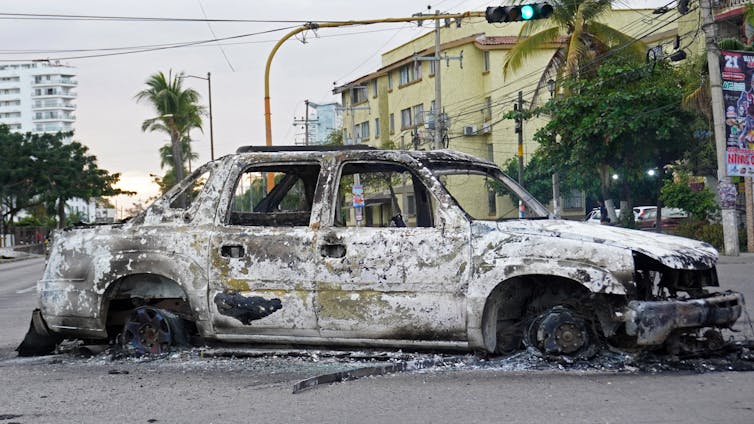
Mexicans have already experienced the immediate aftermath of Oseguera Cervantes’ death: retaliation attacks, blockades and official attempts to prevent civilians from going out. This is similar to what occurred after the capture of drug lord Ovidio Guzmán López in Sinaloa in 2019 and his second capture in 2023.
Violence flares in two ways following such high-profile captures and killings of cartel leaders.
In the short term, there is retaliation. At the moment, members of the Jalisco New Generation Cartel are seeking revenge against Mexico’s security forces and are also trying to assert their regional authority despite El Mencho’s death.
These retaliatory campaigns tend to be violent and flashy. They include blockades as well as attacks against security forces and civilians.
Then there is the longer-term violence associated with any succession. This can take the form of those who are below Oseguera Cervantes in rank fighting for control. But it can also result from rival groups trying to take advantage of any leadership vacuum.
The level and duration of violence depend on a few factors, such as whether there was a succession plan and what kind of alliances are in place with other cartels. But generally, operations in which a cartel boss is removed lead to more violence and fragmentation of criminal groups.
Of course, people like Oseguera Cervantes who have violated laws and engaged in violence need to be captured. But in the long run, that doesn’t do anything to dismantle networks of criminality or reduce the size of their operations.
What is the current state of security in Mexico?
The upsurge in violence after Oseguera Cervantes’ killing occurs as some indicators in Mexico’s security situation seemed to be improving.
But other measures are appalling. Disappearances are still unsettlingly high. The reality that many Mexicans experience on the ground is one where criminal organizations remain powerful and embedded in the local ecosystems that connect state agents, politicians and criminals in complex networks.
Criminal organizations are engaged in what we academics call “criminal governance.” They engage in a wide range of activities and regulate life in communities – sometimes coercively, but sometimes also with some degree of legitimacy from the population.
In some states like Sinaloa, despite the operations to take out cartel’s leaders, the illicit economies are still extensive and profitable. But what’s more important is that levels of violence remain high and the population is still suffering deeply.
The day-to-day reality for people in some of these regions is still one of fear.
And in the greater scheme of things, criminal networks are still very powerful – they are embedded in the country’s economy and politics, and connect to communities in complex ways.
How does the El Mencho operation fit Mexico’s strategy on cartels?
The government of President Claudia Sheinbaum wanted a big, visible hit at a time when the U.S. is pushing for more militarized policies to counter Mexico’s trafficking organizations.
But this dynamic is not new. Most U.S. and Mexican policy regarding drug trafficking organizations has historically emphasized these high-profile captures – even if it is just for short-term gains.
It’s easier to say “we captured a drug lord” than address broader issues of corruption or impunity. Most of the time when these cartel leaders are captured or killed, there is generally no broader justice. It isn’t accompanied with authorities investigating disappearances, murders, corruption or even necessarily halting the flow of drugs.
Captures and killings of cartel leaders serve a strategic purpose of showing that something is being done, but the effectiveness of such policies in the long run is very limited.
Of course, taking out a drug lord is not a bad thing. But if it does not come with a broader dismantling of criminal networks and an accompanying focus on justice, then the main crimes that these groups commit – homicides, disappearances and extortion – will continue to affect the daily life of people. And the effect on illicit flows is, at best, meager.
Angélica Durán-Martínez has received funding from the Harry Frank Guggenheim Foundation, the Social Science Research Funding and the United States Institute of Peace.
This article is republished from The Conversation under a Creative Commons license.