West Bank violence is soaring, fueled by a capitulation of Israeli institutions to settlers’ interests
Reluctance to address settler violence is the outcome of deep social, political and cultural changes, a scholar of Israeli extremist groups argues.
Arie Perliger, Director of Security Studies and Professor of Criminology and Justice Studies, UMass Lowell
15 December 2025
Owais Hammam was walking near his home in Khirbet Bani Harith in the West Bank on Dec. 3, 2025, when, according to media reports, he was kidnapped by Jewish settlers. Over several hours at a nearby settlement, the 18-year-old Palestinian is alleged to have endured repeated beatings, humiliation and harassment.
Israel military soldiers were reportedly involved in the incident, before they eventually released him the next morning. Hamman was hospitalized with multiple injuries and severe psychological trauma.
The alleged attack is far from isolated. The post-Oct. 7, 2023, environment has seen an escalation in settler violence, which has gone from primarily involving vandalism and property destruction to now being marked by kidnapping, prolonged abuse and apparent military complicity. In the two years to October 2025, more than 3,200 Palestinians were “forcibly displaced by settler violence and movement restrictions,” according to United Nations figures.
As a scholar who has studied Israeli extremist groups for over two decades, I contend that the dramatic escalation of settler violence in the West Bank reveals a profound transformation within Israel’s state institutions. Rather than serving as purported neutral enforcers of law and order, the military, Israeli police and the broader governmental apparatus have become increasingly aligned with — and at times directly complicit in — violent settler actions against Palestinians.
This institutional reluctance to address settler violence is not merely a failure of enforcement, I would argue, but a deliberate outcome of deep social, political and cultural changes that have reshaped Israeli society since at least the mid-1990s.
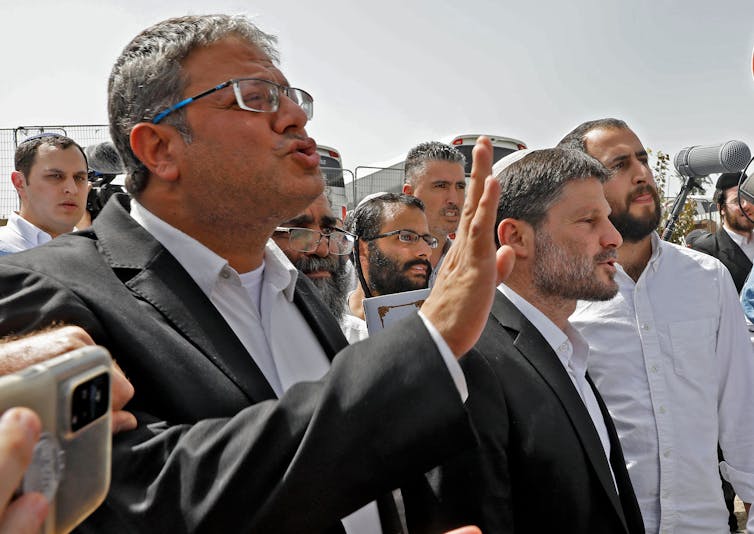
For the first time, key ministerial positions are held by individuals with explicit pro-settler ideologies and personal ties to some of the most violent streams of the settlement movement. Hence, it is not surprising that prominent figures such as Finance Minister Bezalel Smotrich and National Security Minister Itamar Ben-Gvir — both settlers with what has been described as extremist ideologies — have actively implemented policies that facilitate and legitimize settler violence.
For instance, Ben-Gvir has significantly eased firearm regulations, issuing over 100,000 new gun licenses since October 2023, with settlers receiving preferential access.
Smotrich, meanwhile, has publicly distributed security equipment to illegal outposts and allocated substantial budgets for settler militias. This political backing fosters a climate in which settlers feel emboldened to act with impunity.
Itamar Ben-Gvir, left, and Bezalel Smotrich, center, talk to reporters as they visit the Sheikh Jarrah neighborhood in East Jerusalem on May 10, 2021.Gil Cohen-Magen/AFP via Getty Images
Beyond individual ministers, the Israeli government has pursued structural reforms that systematically undermine institutional checks on settler violence.
The transfer of the main Israeli governing body in the West Bank — the Civil Administration authority — from military central command to Smotrich’s Finance Ministry represents a fundamental shift in governance. For decades, the Civil Administration coordinated the provision of West Bank services such as health and education. It also served as an instrument for coordinating with the Palestinian Authority, the body entrusted per the Oslo Accords with limited self-rule over parts of the occupied West Bank.
By placing the Civil Administration under political control rather than independent military command, the government has weakened one of the few mechanisms capable of restraining settler expansion.
Concurrent to these developments has been a blurring of lines between civilian settlers and uniformed security personnel. After Oct. 7, 2023, Israeli authorities distributed 8,000 army rifles to so-called civilian settlement defense squads and regional defense battalions.
These armed settler groups now operate alongside — and are increasingly indistinguishable from — official security forces. Settlers frequently wear official uniforms and carry army-issued weapons during attacks on Palestinians.
I would suggest that this geographic and institutional proximity makes neutral policing nearly impossible.
The cultural and social dimensions of this phenomenon run even deeper. Many settlers serve as army reservists, creating overlapping identities between civilian and military personnel.
Civilian security coordinators, who are responsible for coordination between the military and the settlements’ own “defense squads,” actively shape military operational policy. They help define settlement boundaries, determine areas prohibited to Palestinians and occasionally command soldiers.
Soldiers typically interpret clashes as friction between civilians rather than crimes requiring intervention. When violence intensifies, they often declare an “emergency situation” and defend settlers rather than protecting Palestinian victims.
Societal shifts
The transformation of Israeli institutions reflects broader societal changes where the settler movement has evolved from one of many societal factions to a dominant political force.
Settlers hold key positions in government and military leadership and exercise considerable political influence.
As a result, settler violence has become increasingly embedded in the operational logic of state institutions, turning law enforcement bodies from ostensibly neutral arbiters into what international observers increasingly describe as enablers or participants in systematic violence against Palestinians.
It represents, I would argue, a fundamental reorientation of state power in explicit service of settler expansionism.
Moreover, the failure to hold perpetrators of settler violence to account reveals the extent of the institutional capture. Between 2005 and 2023, more than 93% of police investigations into settler violence were closed without indictment – and only 3% resulted in convictions.
In 2021, the last year for which I was able to obtain data, Israeli authorities opened just 87 investigations for “ideologically motivated offenses,” while U.N. monitors documented 585 incidents.
Nonetheless, the judicial architecture historically accommodates settlement expansion. Settlers are subject to Israeli civilian law, including the ability to vote in Israeli elections while Palestinians face military law, producing vastly asymmetrical outcomes in cases involving violence and property rights.
The country’s Supreme Court, while occasionally striking down discriminatory measures against Palestinians, has bowed to security rationales that permit the broader settlement enterprise to proceed. For example, in 2022, the court rejected a petition to return Palestinian land in the city of Hebron, ruling that an Israeli presence is part of the military’s “regional security doctrine.”
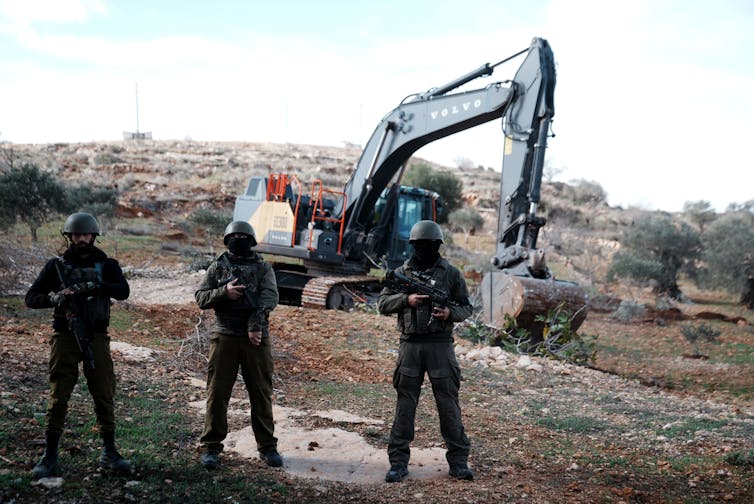
Israeli soldiers stand by as Israeli construction vehicles destroy agricultural lands and uproot centuries-old olive trees in the village of Karyut, West Bank, on Dec. 8, 2025.Issam Rimawi/Anadolu via Getty Images
In addition to the humanitarian concerns, this pattern of violence-driven displacement undermines the viability of a two-state solution, which has returned to international discourse as the centerpiece of “day after” planning for Gaza. It also undermines any claim Israel might make that in lieu of a two-state solution, it can enforce the rule of law equally across people living in territories under its control.
So while international actors focus on ceasefire negotiations and reconstruction, the violence in the West Bank undermines the territorial and demographic foundations necessary for Palestinian statehood and makes the prospect of a lasting ceasefire more distant. The implications of that for a just future are indeed dire.
Arie Perliger does not work for, consult, own shares in or receive funding from any company or organization that would benefit from this article, and has disclosed no relevant affiliations beyond their academic appointment.
This article is republished from The Conversation under a Creative Commons license.