Why corporate America is mostly staying quiet as federal immigration agents show up at its doors
Federal immigration raids in Minnesota prompted a social backlash. But the business community is largely hedging its bets due to a changed political calculus.
Alessandro Piazza, Assistant Professor of Strategic Management, Rice University
6 February 2026
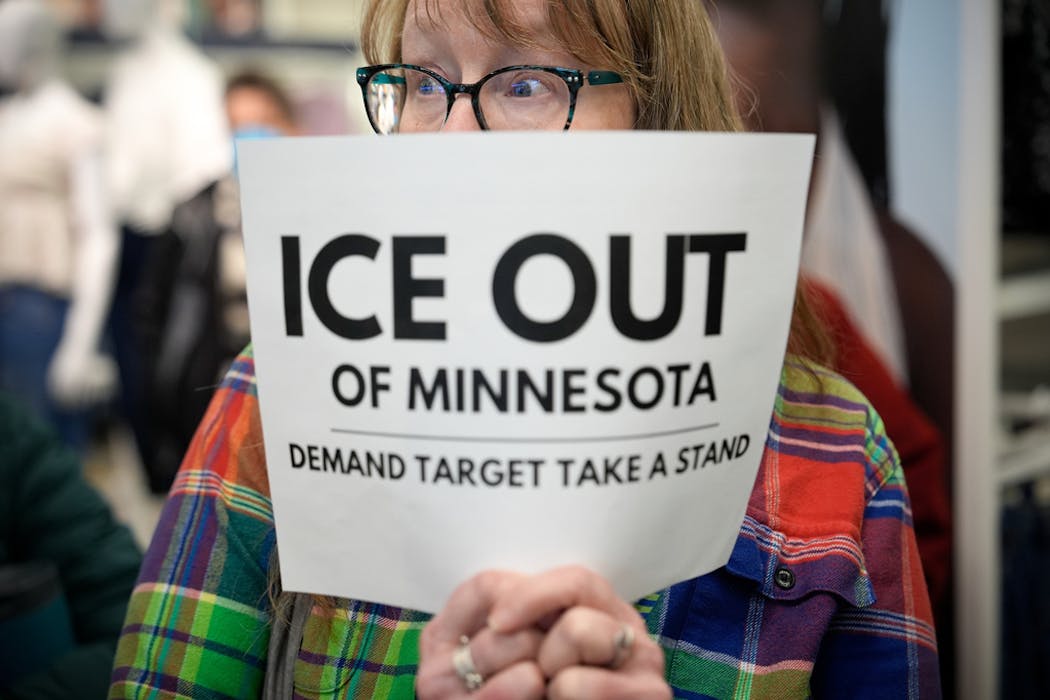
People protest U.S. Immigration and Customs Enforcement inside a Target store in Minneapolis on Jan. 31, 2026.
AP Photo / Julia Demaree Nikhinson
When U.S. Border Patrol agents entered a Target store in Richfield, Minnesota, in early January, detaining two employees, it marked a new chapter in the relationship between corporate America and the federal government.
Some retailers report revenue drops of 50% to 80% as customers stay home out of fear. Along Lake Street and in East St. Paul, areas within the Twin Cities, an estimated 80% of businesses have closed their doors at some point since the operations began.
Then came the killing of U.S. citizens Renee Good and Alex Pretti, the latter of which came a day after widespread protests and a one-day business blackout involving over 700 establishments.
The response of corporate America to those killings was instructive — both for what was said and left unsaid. After the Pretti killing, more than 60 CEOs from Minnesota’s largest companies — Target, 3M, UnitedHealth Group, U.S. Bancorp, General Mills, Best Buy and others — signed a public letter organized by the Minnesota Chamber of Commerce. The letter called for “peace,” “focused cooperation” among local, state and federal officials, and a “swift and durable solution” so that families, workers and businesses could return to normal.
What it didn’t do was name Pretti, mention federal immigration enforcement or criticize any specific policy or official. It read less like moral leadership and more like corporate risk management.
As a researcher who studies corporate political engagement, I think the Minnesota CEO letter is a window into a broader shift. For years, companies could take progressive stances with limited risk — activists would punish them if they remained silent on an issue, but conservatives rarely retaliated when they spoke up. That asymmetry has collapsed. Minneapolis shows what corporate activism looks like when the risks cut both ways: hedged language, no names named and calls for calm.
A shifting pattern
In 2022, after the Supreme Court overturned Roe v. Wade, corporate America was remarkably quiet compared with its vocal stances on LGBTQ+ rights or the war in Ukraine.
The explanation: Companies tend to hedge on issues that are contested and polarizing. In my research with colleagues on companies taking stances on LGBTQ+ rights in the United States, I’ve found that businesses frame their stances narrowly when issues are unsettled — focusing on workplace concerns and internal constituencies like employees rather than broader advocacy. Only after issues are legally or socially settled do some companies shift to clearer activism, adopting the language of social movements: injustice, moral obligation, calls to action.
U.S. Border Patrol’s Gregory Bovino walks through a Target store on Jan. 11, 2026, in St. Paul, Minn.AP Photo/Adam Gray
By that logic, the Minnesota CEOs’ caution makes sense. The Trump administration’s federal immigration enforcement policy is deeply contested. There’s no clear legal or social settlement in sight.
But something else has changed since 2022 — something that goes beyond any particular issue.
For years, corporate activism operated under a favorable asymmetry that allowed them to stake out public positions on controversial topics without much negative consequence.
That is, activists and employees pressured companies to speak out on progressive causes, and silence carried real costs. Meanwhile, conservatives largely subscribed to free-market economist Milton Friedman’s view that the only social responsibility of business is to increase its profits. They generally didn’t demand corporate stances on their issues, and they didn’t organize sustained punishment for progressive corporate speech.
That asymmetry has collapsed
During the Black Lives Matter protests of 2020, corporations rushed to declare their commitments to racial justice, diversity and social responsibility. Many of those same companies have since quietly dismantled diversity, equity and inclusion programs, walked back public commitments and gone silent on issues they once called moral imperatives. It appears that their allegedly deeply held values were contingent on a favorable political environment. When the risks shifted, the values evaporated.
In other high-profile examples, Delta lost tax breaks in Georgia after ending discounts for National Rifle Association members following the Parkland shooting. And Bud Light lost billions in market value after a single social media promotion that featured Dylan Mulvaney, a transgender influencer.
Conservatives learned to play the game that progressive activists invented. And unlike consumer boycotts, government retaliation carries a different kind of weight.
People visit Magic Kingdom Park at Walt Disney World Resort in Lake Buena Vista, Fla., on April 22, 2022.AP Photo/Ted Shaffrey
Minneapolis reveals the new calculus
What makes Minneapolis distinctive is that the federal government isn’t a distant policy actor debating legislation in Washington. It’s a physical presence in companies’ daily operations. When federal agents can show up at your store, detain your employees, raid your parking lot and audit your hiring records, the calculation about whether to criticize federal policy looks very different than when the worst-case scenario is an angry tweet from a politician.
Research finds that politicians are less willing to engage with CEOs who take controversial stances – even in private meetings – regardless of local economic conditions or the politicians’ own views on business. The chilling effect is real. As one observer noted, Minnesota companies communicated through industry associations specifically “to avoid direct exposure to possible retaliation.”
“De-escalation,” then, has become the corporate buzzword of choice because, as one news report in The Wall Street Journal noted, it “sounds humane while remaining politically noncommittal.” It points to a process goal – reduce conflict, restore order – rather than a contested diagnosis of responsibility.
And yet the situation within companies is also full of internal tensions, whether they’re companies headquartered in Minnesota or not. At tech company Palantir, which holds contracts with U.S. Immigration and Customs Enforcement, employees took to internal Slack channels after Pretti’s death to express that they felt “not proud” to work for a company tied to what they described as “the bad guys.” Similar sentiments could be seen at elsewhere, where rank-and-file employees expressed far more vocal outrage than their bosses.
What comes next
The Minnesota CEO letter is what corporate political engagement looks like when the risks run in every direction: no injustice framing, no attribution of blame, no names named — just calls for stability and cooperation.
It’s not cowardice, exactly. It’s what the research predicts when an issue is contested and the costs of speaking cut both ways.
But it does mean Americans shouldn’t expect corporations to lead when government power is directly at stake. The conditions that enabled corporate activism on LGBTQ+ rights — an asymmetry where speaking out was relatively low-risk — don’t exist here.
Until the political landscape shifts, the hedged statement and the cautious coalition letter are the new normal. Corporate activism, it turns out, might always have been more about positioning than principle.
Alessandro Piazza does not work for, consult, own shares in or receive funding from any company or organization that would benefit from this article, and has disclosed no relevant affiliations beyond their academic appointment.
This article is republished from The Conversation under a Creative Commons license.