What northern NZ’s wet and sticky summer reveals about our warming atmosphere
Behind this summer’s floods and slips is a simple signal we rarely talk about: humidity. As the climate warms, NZ will need to pay closer attention.
Kevin Trenberth, Distinguished Scholar, NCAR; Affiliate Faculty, University of Auckland, Waipapa Taumata Rau
18 February 2026
New Zealand’s summer has been defined by repeated bursts of intense rain, as subtropical systems have swept down over the upper North Island and beyond.
Floods, slips and storm damage – most recently in Christchurch – have dominated the headlines. But many of the season’s events have come with another feature we rarely talk about: the sheer amount of moisture in the air before the rain even starts.
Even by Auckland’s standards, recent humidity readings have been notable.
On February 2, the Whangaparaoa automatic weather station on the city’s North Shore recorded a temperature of 24°C with 98% relative humidity. That implied the dew point – a direct measure of humidity – also came close to 24°C, making for conditions not merely muggy, but oppressive.
A fortnight earlier, on January 21–22, humidity in Tauranga reached similarly sticky levels, with dew point measuring 20C to 24C. Over that period, a record-breaking 274mm of rain fell within 24 hours, triggering separate landslides that claimed eight lives.
While humidity is often treated as just an uncomfortable part of summer in the upper North Island, it can, like extreme rainfall, tell us something important about the warming state of our atmosphere.
It also presents a real risk to human health that can be overlooked when we focus on temperature alone.
Why heat feels worse when the air is wet
Over summer, weather reports and television forecasts typically focus on maximum temperature and almost never mention humidity in any form. Yet it is a major factor in New Zealand’s weather – and our comfort depends on it as much as on temperature.
Our bodies continuously exchange heat with the environment through conduction, convection, radiation and evaporation. Humidity strongly influences how effective the body’s natural cooling systems are – particularly sweating – and this becomes critical at higher temperatures.
The range where most people feel comfortable is roughly between 22°C and 27°C, when humidity is favourable.
Typically, humidity is expressed as relative humidity, which gives the percentage of moisture in the air compared with the maximum it could hold at that temperature. But this measure goes up and down with temperature, while the moisture content of air does not.
A far better indicator is the dew point, the temperature at which air becomes saturated and water vapour begins to condense.
Most people start to feel uncomfortable when the dew point rises above about 16C and conditions can become difficult to bear above 21°C. A high dew point means sweat evaporates poorly and heat stress increases. A day that is 30°C can feel pleasant in dry air, but hard to handle in humid air.
When temperatures reach extreme levels, however, even very dry air can become dangerous. Amid a recent heatwave in southeast Australia, Melbourne recorded maximum temperatures of 41°C and 43°C on January 7 and 9 respectively, with some western and northern suburbs exceeding 45°C.
Despite relative humidities of around 15% and a dew point of less than 12°C, the heat was still extreme. Evaporative cooling still occurs, but at these temperatures the human body can still be overwhelmed.
A climate change calling card
Owing to its maritime climate, New Zealand seldom experiences temperatures above 30°C. When these do occur, they mainly come amid dry north-westerly flows in eastern parts of the country, such as Canterbury and Hawke’s Bay.
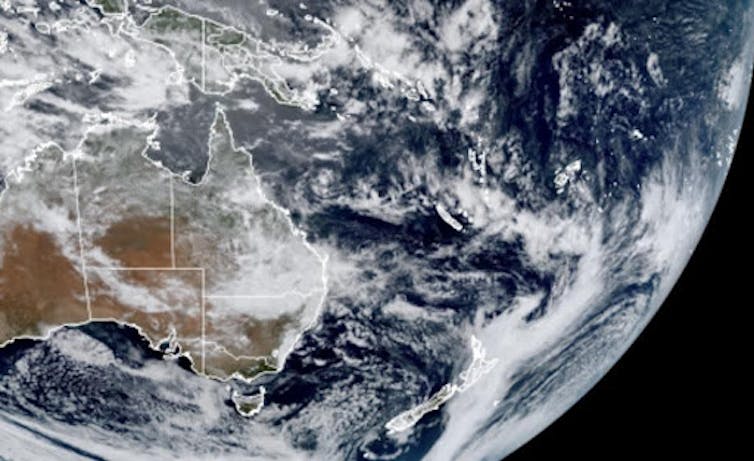
A moisture-laden weather system that began as an atmospheric river, observed by the Japanese Meteorological Agency’s Himawari satellites, hangs over New Zealand on February 14.JMA, CC BY-NC-ND
In summer, the upper North Island is much more used to background humidity. In Auckland, for instance, the dew point typically hovers between 17°C and 18°C, which is noticeable but not oppressive. On very humid days, often with northerly winds, those values can easily exceed 20°C.
This is just what people experienced in late January when a series of storms passed across the region, bringing intense rain and moisture. These events happened to come as part of a wider “atmospheric river” – long, thin filaments of atmospheric moisture that can stretch thousands of kilometres from the subtropics to New Zealand.
Over recent years, these systems have been responsible for some of the country’s most damaging weather events. As the climate warms, the atmosphere can hold more moisture, meaning atmospheric river events are likely to grow even more frequent and intense, while also raising health risks that come with high humidity.
Another reason for the run of wet and humid weather this summer has been the influence of a fading La Niña climate pattern, which favours warmer seas around New Zealand and more frequent subtropical flows from the north.
Besides driving up local humidity levels, these visiting weather systems can worsen the risk of landslips and landslides – particularly when they bring sudden, heavy downpours after long dry spells have left the ground cracked and vulnerable. In the East Cape region, more than 11,000 slips and landslides were recorded in January alone.
All of this means humidity is more than a source of discomfort and potential heat stress, but an early warning signal of a moisture-laden atmosphere and the risks that come with it.
As our planet continues to heat, measuring and reporting dew point, in both New Zealand and Australia, should become the norm.
Kevin Trenberth does not work for, consult, own shares in or receive funding from any company or organisation that would benefit from this article, and has disclosed no relevant affiliations beyond their academic appointment.
This article is republished from The Conversation under a Creative Commons license.