Bad Bunny says reggaeton is Puerto Rican, but it was born in Panama
Emerging from a swirl of sonic influences, reggaeton began as Panamanian protest music long before Puerto Rican artists turned the genre into a global phenomenon.
Brendan Frizzell, PhD Student in Sociology, USC Dornsife College of Letters, Arts and Sciences
2 March 2026
Bad Bunny likes to remind the world where he and his music come from.
In “EoO,” a song from his 2025 album “DeBÍ TiRAR MáS FOToS,” he raps, “‘Tás escuchando música de Puerto Rico” (“You’re listening to music from Puerto Rico”). Similarly, in the album’s second track, “VOY A LLeVARTE PA PR,” he announces that both he and reggaeton were born in Puerto Rico: “Aquí nací yo y el reggaetón, pa’ que sepa’.”
In my own research of Latin America, I’ve explored how reggaeton comes from the small Central American nation of Panama, where the sound emerged from a swirl of sonic influences that included Spanish conquistadors, Caribbean immigrants and American colonizers.
English and Spanish collide
Understanding reggaeton requires understanding the intermingling of cultures and languages that Panama experienced over a relatively short period of time.
After Panama gained its independence from Spain in 1821, it became part of Gran Colombia, which, at its peak, included modern-day Colombia, Venezuela, Ecuador and Panama.
Throughout the 19th century, Panama experienced population growth and mass industrialization, and waves of Afro Caribbean immigrants arrived in northern Panama in search of economic opportunities. Since they came from former British colonies, many of them spoke English. Meanwhile, the many Afro Panamanians already living in the country, whose descendants had been trafficked as slaves, spoke Spanish.
In 1903, Panama separated from Gran Colombia, becoming the independent nation we know today. The U.S. had supported Panama’s independence for strategic reasons: It wanted to build and control the Panama Canal to secure influence over maritime trade and military movement in the Western Hemisphere. While Gran Colombia had rebuffed earlier U.S. overtures, leaders of the newly independent Panama were more receptive to American interests.
Jim Crow is imported to the Canal Zone
Police brutality, exploitation and intra-racial and interracial tensions also served as scaffolding for reggaeton.
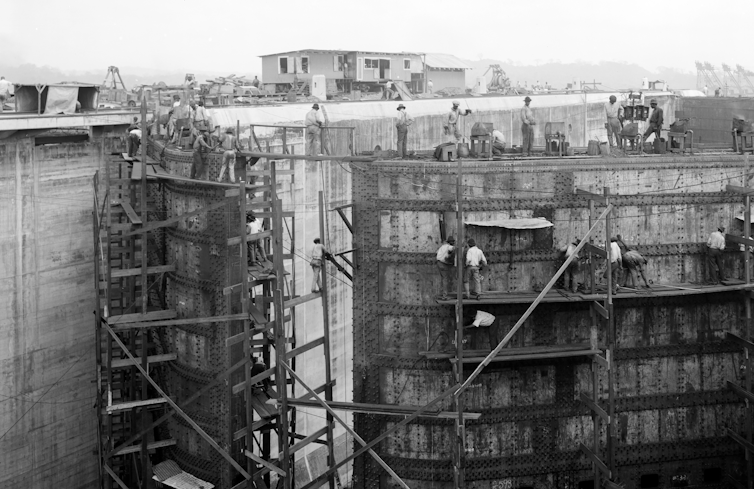
During the canal’s construction, the U.S. operated and controlled the Panama Canal Zone, a 553 square-mile (1,432 square-kilometer) parcel of land encompassing the canal. Up to 60,000 people lived there while the canal was being built, with residents segregated by race into “gold roll” and “silver roll” workers. Gold roll workers were usually white. Silver roll workers were Black, and they were tasked with the most dangerous jobs.
West Indians and Afro Panamanians also experienced police brutality. Black women, in particular, were harassed by white police officers, who often accused them of sex work.
While both West Indians and Afro Panamanians were subjected to segregation and police brutality, the Americans running the Canal Zone tended to treat the English-speaking West Indians better. Meanwhile, children born and raised in the Canal Zone were only taught English in schools, which Afro Panamanians resented.
These tensions led to the rise of “panameñismo,” a movement that sought to preserve and promote Spanish language and culture in Panama. This movement culminated in the passing of restrictive immigration laws targeted at West Indians and stripping second-generation West Indians of their citizenship.
Despite these anti-West Indian policies, many Jamaican, Barbadian and Antillean immigrants who had already built a life in Panama remained in the country even after the canal was completed in 1914.
The lyrics were in English and Jamaican Patois, an English-based creole language. But it didn’t take long for an offshoot of reggae, “reggae en español,” to emerge. By the end of the 1970s, reggae en español had become popular in Panama and had spread throughout Latin America. Similarly, the nascent genre of hip-hop was gaining steam in the U.S. and eventually made its way to Panama, where an American presence had remained since the completion of the canal. It wasn’t until 1979 that the Canal Zone was abolished, and Panama did not have ownership over the canal until 2000.
It was out of this diverse mix of musical and linguistic influences that reggaeton was born, a genre that features the looping drum pattern – called “dembow riddim” – of Jamaican dancehall, the tropical vibe of reggae and a mixture of rapping and singing. Like reggae and hip-hop, reggaeton lyrics often emphasize Black solidarity and speak out against racial oppression and police violence.
The Panamanian artist Renato is credited with releasing the first reggaeton song, titled, “El D.E.N.I.,” in 1985.
The D.E.N.I. – an acronym for the Departamento Nacional de Investigaciones, or National Department of Investigations – was a tool of repression for Panama’s military dictatorship under Omar Torrijos in the 1970s and later under Manuel Noriega in the 1980s. The secret police force became entangled in drug trafficking and political corruption.
In ‘El D.E.N.I.,’ Renato denounces police brutality and racism.
In the song, Renato assumes the role of a racist police officer, the kind he encountered after relocating from the Canal Zone to Rio Abajo, an impoverished neighborhood in Panama City:
Even though El General primarily produced music, one of his tracks, “No Mas Guerra,” channeled the fighting spirit of original reggaeton, calling for Latin American communities to come together to end violence and wars.
Daddy Yankee’s music spread, in part, thanks to American brands like Kellogg’s and Reebok, whose ads featuring his songs were broadcast to American audiences. Few of his tracks contained the social justice themes that characterized early reggaeton.
Reggaeton was born out of a call for freedom, equality and justice. So I find it fitting that Bad Bunny is creating music that speaks to all types of people from all over the world.
Brendan Frizzell does not work for, consult, own shares in or receive funding from any company or organization that would benefit from this article, and has disclosed no relevant affiliations beyond their academic appointment.
This article is republished from The Conversation under a Creative Commons license.
RUGBY Crusaders prop Tamaiti Williams has been cited for what's been deemed a reckless or dangerous act during their Super Rugby win over the Chiefs in Hamilton More...
BUSINESS A warning Dunedin's Forsyth Barr Stadium is in a financially unsustainable position More...