Frank Gehry, the architect of the unconventional, the accidental, and the inspiring, has died at 96
Frank Gehry, who has died at 96, leaves a powerful legacy, visible in many major cities, in the media, in galleries and in popular culture.
Michael J. Ostwald, Professor of Architectural Analytics, UNSW Sydney
8 December 2025
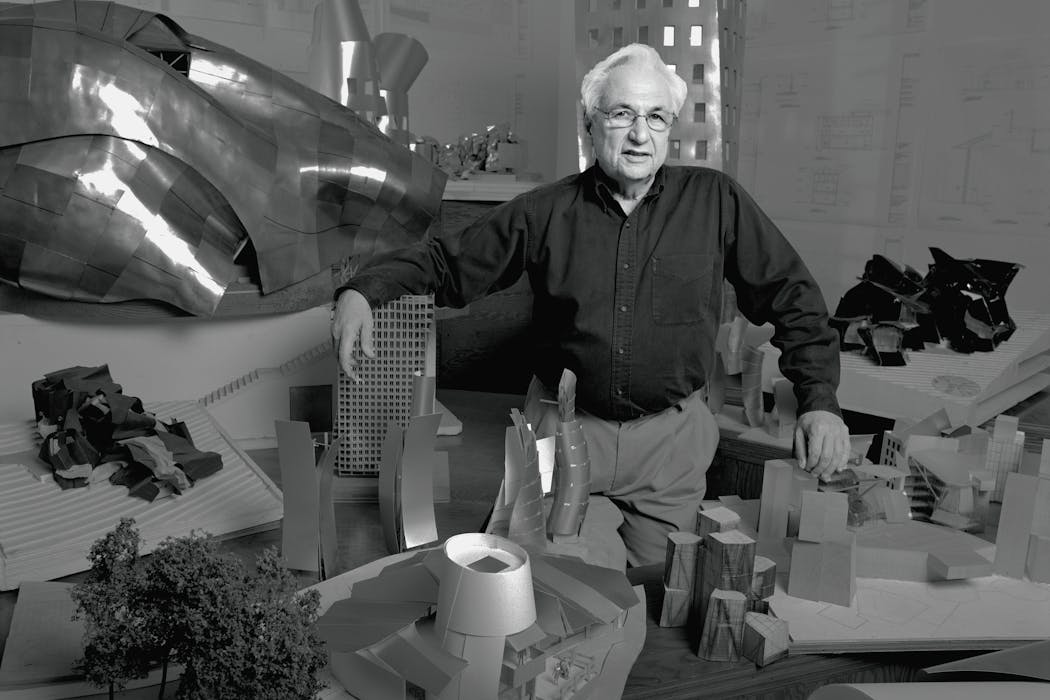
Architect Frank Gehry poses with miniatures of his designs in Los Angeles in 1989.
Bonnie Schiffman/Getty Images
In April 2005, The Simpsons featured an episode where Marge, embarrassed by her hometown’s reputation for being uneducated and uncultured, invites a world-famous architect to design a new concert hall for the city.
The episode cuts to the architect, Frank Gehry (playing himself), outside his house in Santa Monica, receiving Marge’s letter. He is frustrated by the request and crumples the letter, throwing it to the ground. Looking down, the creased and ragged paper inspires him, and the episode cuts to a model of his concert hall for Springfield, which copies the shape of the crumpled letter.
By building Gehry’s design, the people of Springfield hoped to send a signal to the world that a new era of culture had arrived. As it often did, this episode of The Simpsons references a real-life phenomenon, which Gehry was credited with triggering, the “Bilbao effect”.
In 1991, the city of Bilbao in northern Spain sought to enhance its economic and cultural standing by establishing a major arts centre. Gehry was commissioned to design the Bilbao Guggenheim, proposing a 57-metre-high building, a spiralling vortex of titanium and glass, along the banks of the Nervión River.
Using software developed for aerospace industries, Gehry designed a striking, photogenic building, sharply contrasting with the city’s traditional stone and masonry streetscapes.
Finished in 1997, the response to Gehry’s building was overwhelming. Bilbao was transformed into an international tourist destination, revitalising the city and boosting its cultural credentials and economic prospects. As a result, many cities tried to reproduce the so-called “Bilbao effect” by combining iconic architecture and the arts to encourage a cultural renaissance.
Gehry, who has died at 96, leaves a powerful legacy, visible in many major cities, in the media, in galleries and in popular culture.
An architect’s life
Gehry was born Frank Owen Goldberg in Toronto, Canada, in 1929 and emigrated to Los Angeles in the late 1940s, where he changed his surname to Gehry. He studied architecture and urban planning and established a successful commercial practice in 1962.
It wasn’t until the late 1970s, when he began experimenting with alterations and additions to his own house, that he began to develop his signature approach to architecture. An approach that was both visionary and confronting.
Gehry and his son, Alejandro, in the yard in front of his self-designed home, Santa Monica, California, January 1980.Susan Wood/Getty Images
In 1977, Gehry purchased a colonial bungalow on a typical suburban street in Santa Monica. Soon after, he began peeling back its cladding and exposing its structural frame. He added a jumble of plywood panels, corrugated metal walls, and chain-link fencing, giving the impression of a house in a perpetual state of demolition or reconstruction.
Its fragmented, unfinished expression offended the neighbours but also led to his being exhibited in the landmark 1988 Museum of Modern Art’s Deconstructivist Architecture show.
At this event, Gehry’s house was featured alongside a range of subversive, anti-establishment works, catapulting him to international fame.
The Walt Disney Concert Hall, Los Angeles, California, United States of America.Tim Cheung/Unsplash
Unlike other architects featured in the exhibition – such as Coop Himmelblau, Rem Koolhaas and Daniel Libeskind – Gehry was not driven by a political or philosophical stance. Instead, he was interested in how people would react to the experience of architecture.
It was only after the Bilbao Guggenheim was completed that the world could see this vision.
Throughout the 2000s, Gehry completed a range of significant buildings, led by the Walt Disney Concert Hall (2003) in Los Angeles, which has a similar style to the Bilbao Guggenheim.
Gehry’s Museum of Pop Culture (2000) in Seattle is a composition of anodised purple, gold, silver and sky-blue forms, resembling the remnants of a smashed electric guitar.
Museum of Pop Culture, Seattle, Washington, United States of America.Getty Images
The Marqués de Riscal Vineyard Hotel (2006) in Elciego, Spain, features steel ribbons in Burgundy-pink and Verdelho-gold. The Louis Vuitton Foundation (2014) in Paris has 12 large glass sails, swirling around an “iceberg” of concrete panels.
Gehry only completed one building in Australia, the Dr Chau Chak Wing Building (2014) in Sydney. Its design, an undulating form clad in custom-made bricks, was inspired by a crumpled brown paper bag. Marge Simpson would have approved.
Recognition and reflection
The highest global honour an architect can receive is the Pritzker Prize, often called the “Nobel prize for architecture”. Gehry was awarded this prize in 1989, with the jury praising his “controversial, but always arresting body of work” which was “iconoclastic, rambunctious and impermanent”.
While the Pritzker Prize is often regarded as a capstone for a career, most of Gehry’s major works were completed after the award.
Tempranillo vines surround the hotel at Marqués de Riscal winery, Elciego, Spain.David Silverman/Getty Images
Gehry revelled in experimentation, taking artistic inspiration from complex natural forms and constructing them using advanced technology. Over the last three decades, his firm continued to produce architecture that was both strikingly sculptural and playfully whimsical.
He ultimately regretted appearing on The Simpsons, feeling it devalued the complex process he followed. His architecture was not random; an artist’s eye guided it, and a sculptor’s hand created it. It was not just any crumpled form, but the perfect one for each site and client.
He sometimes joked about completing his home in Santa Monica, even humorously ending his acceptance speech for the Pritzker Prize by saying he might use his prize money to do this. Today, on the corner of 22nd Street and Washington Avenue, partly shielded by trees, Gehry’s house remains forever a work in progress. Its uncompromising yet joyful presence has endured for almost 50 years.
Michael J. Ostwald does not work for, consult, own shares in or receive funding from any company or organisation that would benefit from this article, and has disclosed no relevant affiliations beyond their academic appointment.
This article is republished from The Conversation under a Creative Commons license.