The AI boom feels eerily similar to 2000’s dotcom crash – with some important differences
With investor unease over AI stocks having just wiped a trillion dollars from markets, have we really learned the big lessons from 25 years ago?
Rod McNaughton, Professor of Entrepreneurship, University of Auckland, Waipapa Taumata Rau
11 November 2025
If last week’s trillion-dollar slide of major tech stocks felt familiar, it’s because we’ve been here before – when hype about innovation last ran headlong into economic reality.
As markets slump on the back of investor unease over soaring valuations of artificial intelligence (AI) companies, commentators are asking the same question they were during the dotcom crash 25 years ago.
Can technology really defy basic economics?
It’s a question I discussed in my inaugural professorial lecture at the University of Otago back in August 2000, just as internet stocks were tumbling and hundreds of dotcoms were failing.
I argued then that many internet firms were “naked” because their business models were visible for all to see. They spent vast sums to attract customers with no credible path to profit.
A generation later, the same logic is driving the AI boom.
Different metrics, same story
In 2000, the internet promised to revolutionise commerce, with success measured in “eyeballs” and “clicks” rather than profit. Today, those indicators have become “tokens processed” and “model queries”.
The language might have changed, but the belief that scale automatically leads to profit hasn’t.
Just as we heard the internet was going to remove intermediaries – cutting out traditional middlemen like retailers and brokers – there have been promises that AI will remove cognitive labour.
Both have encouraged investors to overlook losses in pursuit of long-term dominance.
At the height of the dotcom frenzy, companies such as online retailer eToys spent lavishly on marketing to win customers. Today, AI developers invest billions in computing power, data and energy – yet still remain unprofitable.
Nvidia’s multi-trillion dollar valuation, OpenAI’s continuing losses despite surging revenue, and the flood of venture funding into AI start-ups all echo the 1999 bubble.
Then, as now, spending is mistaken for investment.
What the dotcom crash should have taught us
Back in 2000, I suggested internet firms were building market-based assets such as brand value, customer relationships and data, which could create genuine value only if they produced loyal, profitable customers.
The problem was that investors treated spending as proof of growth and marketing as a business model in its own right.
Data sets, model architectures and user ecosystems are treated as assets even when they have yet to generate positive returns.
Their value rests on faith that monetisation will eventually catch up with cost. The logic remains the same; only the story has changed.
The dotcom boom was driven by fragile start-ups fuelled by venture capital and public enthusiasm.
Today’s AI surge is led by powerful incumbents like Microsoft, Google, Amazon, and Nvidia, which can sustain years of losses while chasing dominance. That reduces systemic risk but concentrates market power.
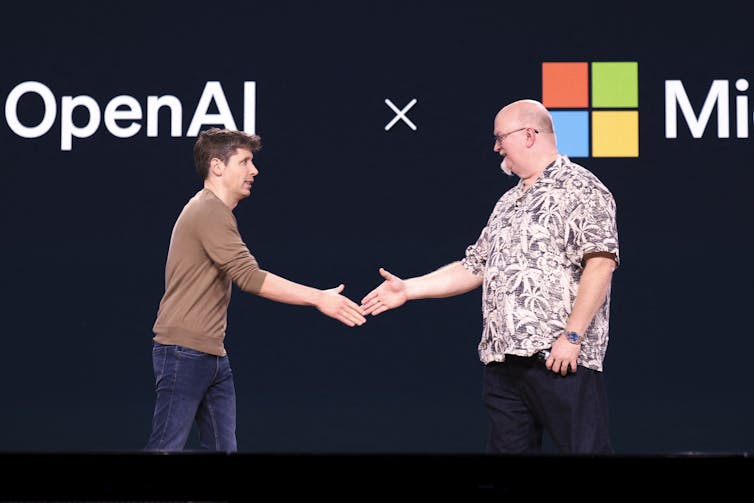
OpenAI chief executive Sam Altman (left) shakes hands with Microsoft’s Kevin Scott in Seattle last year. Big companies are dominating the AI boom.Getty Images
Where the money goes has also shifted. Internet firms once burned cash on advertising. AI companies burn it on computing power and data.
The spending has moved from the marketing agency to the data centre, yet the question remains: does it create real value or only the illusion of progress?
AI also reaches deeper than the internet. The web has transformed how we communicate and shop, but AI is shaping how we think, learn and make decisions.
If a crash comes, it could erode public trust in the technology itself and slow innovation for years. Relatively low real interest rates and abundant capital have also contributed to fuelling this current wave of technology investment.
Much like the late-1990s boom, when favourable monetary policy helped underwrite a surge in tech valuations, this cycle shows how the macro-financial backdrop can amplify technological optimism.
The return of intangible mania
Despite these differences, the pattern of valuation is familiar. Investors are again pricing potential over performance.
In 2000, analysts justified valuations by counting users a company might one day monetise. In 2025, they model “inference demand” and “data advantage”. Both are guesses about an imagined future.
Narrative has become capital as markets reward conviction over evidence. The danger is not technological failure but economic distortion when storytelling outpaces solvency.
Even profitable firms can be caught in the downdraft.
In 2000, leaders such as Yahoo! and eBay lost most of their market value when the bubble burst, despite their long-term survival. The same could happen to today’s AI giants.
Two lessons still stand. First, scalability without profitability is not a business model. Exponential growth can deepen losses rather than reduce them.
Each additional AI query carries a real computational cost, so growth matters only when it leads to sustainable margins.
Second, intangible assets must create measurable value: marketing, data and algorithms are assets only when they produce lasting cash flow or clear social benefits.
For policymakers, the implication is clear: fund AI projects that deliver tangible productivity or social benefits, rather than merely fuelling hype.
While AI will transform how we work and think, it cannot abolish the connection between cost, value and customer need. Lasting value comes from providing genuine benefits to people.
The question now is whether AI’s real productivity gains will ultimately justify today’s valuations, as the internet, after a painful correction, eventually did.
Rod McNaughton does not work for, consult, own shares in or receive funding from any company or organisation that would benefit from this article, and has disclosed no relevant affiliations beyond their academic appointment.
This article is republished from The Conversation under a Creative Commons license.