When did people first arrive in Australasia? New archaeogenetics study dates it to 60,000 years ago
New research confirms humans first reached the Sahul super-continent by two different routes around 60,000 years ago.
Martin B. Richards, Research Professor in Archaeogenetics, Department of Physical and Life Sciences, University of Huddersfield
3 December 2025
The question of when people first arrived in the land mass that now comprises much of Australasia has long been a source of scientific debate.
Many Aboriginal people believe they have lived on the land since time immemorial. But until the advent of radiocarbon dating techniques, many western scholars thought they had arrived not long before European contact 250 years ago.
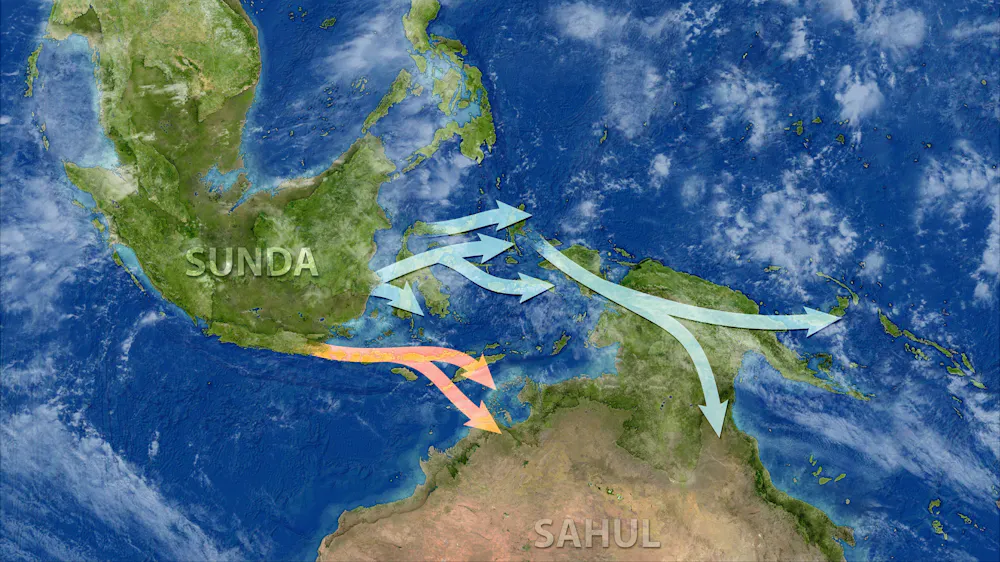
Now a new study by an international collaboration of geneticists and archaeologists, including myself, suggests that humans first arrived in Sahul – the “super-continent” that encompassed New Guinea and Australia during the last ice age – by two different routes around 60,000 years ago.
The research, led by archaeologist Helen Farr at the University of Southampton, also points to the earliest uncontested example of travel by boat – probably simple watercraft such as paddled bamboo rafts or canoes. The first people to arrive would have migrated into the region following a rapid dispersal from Africa around 10,000 years earlier.
The key to the work of our genetics team, based at the University of Huddersfield, is mitochondrial DNA (mtDNA). People only inherit mtDNA from their mothers, so we were able to track an unbroken maternal line of descent down many generations, during which the mtDNA gradually accumulates small mutations.
We sequenced mtDNA genomes in almost 1,000 samples, mainly from New Guineans and Aboriginal people – collected by colleagues at La Trobe University in Melbourne and the University of Oxford, in close collaboration with the communities.
The samples were all collected with the help of Aboriginal elders. The principal elder, Lesley Williams from Brisbane, arranged invitations for the researchers to address Aboriginal groups to explain the purpose of the study and answer any questions before signed consent was given. The results of the analysis of each sample were returned in person whenever possible.
These genealogical trees were then combined with another 1,500 sequences that were already available. By counting the number of mutations from ancestors in these trees, we could use a “molecular clock” to date lineages that were unique to New Guineans, Aboriginal people or both.
After correcting for natural selection (which makes the mutation rate non-linear) and checking the results against well-known colonisation events in the Pacific, we concluded that the deepest lineages were 60,000 years old. Reanalysing previously published male-lineage and genome-wide data found that this also fitted with our results.
Clashing chronologies
The debate about when and how people first arrived in modern-day Australasia was transformed during the 20th century, especially by the introduction and gradual refinement of radiocarbon dating techniques.
This pushed the time of people’s first arrival back to around 45,000 years – ironically, now known as the “short chronology”. However, some archaeologists argued they may have arrived even earlier.
In 2017, newer scientific dating methods – such as optical luminescence dating, which estimates the time quartz grains in the sediments embedding human remains were last exposed to sunlight – supported the so-called “long chronology” of people first arriving in northern Australia at least 60,000 years ago. But this view remainedcontentious.
The pendulum swung again in 2024, as geneticists weighed in with a genetic clock based on the recombination that takes place between pairs of chromosomes with every generation. New results using this clock suggested that interbreeding between early modern humans and Neanderthals, shortly after modern humans left their African homeland, took place less than 50,000 years ago – more recently than had previously been proposed.
All present-day non-Africans carry around 2% Neanderthal DNA, suggesting they must all be descended from that small group. This research therefore supported the short chronology view.
The genetic and archaeological evidence could apparently only be squared if there had been a first wave of early arrivals in Sahul at least 60,000 years ago, that was entirely replaced by a second wave of modern humans around 40,000 years ago. For some experts this seemed implausible, since people were already widespread in Sahul by that time.
Our genetic dates suggest a simpler solution. There was only one wave 60,000 years ago, and these earliest arrivals were the ancestors of today’s New Guineans and Aboriginal people in Australia.
Our results suggest there were two distinct migrations into Sahul – both around the same time about 60,000 years ago. This is because the most ancient lineages fell into two groups.
The major set, with ancestry in the Philippines, was distributed throughout New Guineans and Aboriginal people in Australia. But we also identified another minor set, with ancestry in South Asia or Indochina, only in Aboriginal people. The simplest explanation for these patterns is that there were two dispersals into Sahul: a major northern pathway and a minor southern route.
Both groups of migrating people met more archaic species of human along the way. As well as the 2% Neanderthal DNA that all non-Africans carry, the genomes of modern New Guineans and Aboriginal people in Australia carry a further 5% of archaic human DNA with more local origins – the results of interbreeding in Southeast Asia and perhaps even in Sahul itself.
Even with the lower sea levels 60,000 years ago, that second group must have crossed at least 60 miles (100km) of open sea to reach Sahul – some of the earliest evidence we have for human seafaring. An increasing amount of research suggests maritime technology played a role in early humans’ rapid dispersal from Africa some 10,000 years earlier, taking a coastal route via Arabia to Southeast Asia and beyond.
But the debate about precise timings of these earliest journeys doesn’t end here. We are now analysing whole human genome sequences – each consisting of 3 billion base units, compared with 16,500 for mtDNA – to further test our results. But both kinds of genetic clock – the mutation clock we use, and the recombination clock advocated by others – are indirect evidence. If ancient DNA can eventually be recovered from key remains, we can test these models more directly.
It may happen. Recovering ancient DNA from the tropics is challenging, but in the rapidly evolving world of archaeogenetics, almost anything now seems possible.
Martin B. Richards received funding from the European Research Council's ACROSS (Australian Colonisation Research: Origins of Seafaring to Sahul) grant to Professor Helen Farr under the European Union’s Horizon 2020 research and innovation programme.
This article is republished from The Conversation under a Creative Commons license.
RUGBY Kiwi triathlete Hayden Wilde has only just won the first world title of his career...but he's already looking ahead to next season's T100 World Championship More...
BUSINESS New Zealand's economy is set to expand next year, as several key indicators point to economic recovery More...